Saturday, March 29, 2008

Earth Hour

Tonight at eight o’clock, Brisbane will join the world to observe Earth Hour by turning off its lights for one hour. And the city has urged everyone to do the same.

Well, I’ve got other plans. I just found a place to live and I am moving today. As my stuff is scattered among a few friends’ places, I need to gather them and move them to my new digs. After moving all my boxes and suitcases with my little car all day, I finish the day by shoving my bed into the Little Car That Could and drive back to my new home. It is already eight o’clock when I leave my friend’s place. As I drive along the freeway past the city center, an eerie scene of darkened skyscrapers, punctuated by an occasional bright window here and there, unfolds before me. This is the only time I have seen Brisbane like this – no neon lights on building tops, no floodlighting on the bridges, not even the reflection of the skyline in the Brisbane River. I can’t help but think of my friends in Lubwe, Zambia, who would no doubt be having their Earth Hour when it’s their turn; and they observe it everyday! Soon, I am home and unpacking – with the lights burning bright in my room.

It’s not that I don’t care about the environment; to the contrary, I care so much, I have earned a reputation among my friends for being a tree-hugging, tofu-eating, and organic-munching hippie. To me, the purpose of Earth Hour is to raise awareness of our collective voracious appetite for energy and how it affects our lives and where we live, both locally and globally speaking. We all know that by turning off our lights for one measly hour will do nothing, in the long run, for the environment. It will be a success only if the event convinces people to start conserving energy. I have already been doing my part for a long time, especially since I moved to Brisbane three years ago. I turn off the lights when I leave the room. I line dry my clothes. I eat as local as possible by getting my fruits and vegetables from a community-supported agriculture club and by shopping at the local farmer’s market. I take my own reusable bags to go grocery shopping. I recycle and reuse jars and containers – oh, I am so famous for this one, my friends make fun of me to no end; apparently I am not wasteful enough to be considered “normal” in a developed country. I get around Brisbane by riding my bike almost all of the time and drive only if it’s not practical to ride or to take public transport – like when I am moving.

That’s why I feel like they are preaching to the choir and, to me, Earth Hour is a non-event.

Tuesday, March 25, 2008

Back to Reality

It feels like I have just gotten back from holidays, and now another rotation – medical specialties – is upon us. I have been allocated to the specialties of infectious diseases and geriatrics – four weeks each.

For the next four weeks, I am with the infectious diseases team. Today starts with ward rounds. After a year of being in a laid-back regional hospital, the intensity of the ward round at this major metropolitan hospital just smacks me right in the face – no small talk, it’s all business. The consultant and her entourage – all ten of us registrars, residents, a nurse, a pharmacist, and us medical students – move like an amebic organism from room to room and from ward to ward. We swarm each bed, spreading ourselves out to surround it, throw medical jargons at each other as if we are speaking in code, and occasionally involve the patient in the discussion by offering them a brief translation of our treatment plans. Afterwards, we ooze out of the room, shuffle down the hall, and slither down the stairs to the next unsuspecting patient in a distant ward.

Compared to the kinds of infectious diseases I saw on my elective, the ones here are fairly tame – MRSA, VRE, and an occasional necrotizing fasciitis – at least in terms of getting appetite-suppressing photos. With all the powerful antibiotics at the doctors’ disposal, many of these infections are brought under control quickly. It’s like in Zambia, they are fighting a war with little pistols whereas here, they can have the latest heat-seeking missiles at a moment’s notice. And here at the infectious diseases ward is where the eternal battle between nasty bugs and man’s ingenuity is fought. We are always trying to stay one step ahead of the bugs by finding their Achilles’ Heel and exploiting their vulnerability. On the other hand, the bugs are always mutating in an unpredictable way for survival under the evolutionary pressure from the drugs we throw at them. At the moment, we have the upper hand.

But I wonder for how much longer.

Saturday, March 22, 2008

Homeless, Need Shelter

I’m back in Brisbane, and I am homeless.

After staying in student housing in Hervey Bay last year, I went on various trips for almost four months. My stuff is scattered among a few friends’ places. For now, my friends Richard and Henry are running a shelter out of their living room floor and have taken me in.

So the immediate priority is to find a place to live; my jetlag can wait. As I have been told, housing cost in Brisbane has gone up substantially in the last year. Throw in the freefalling US dollar, I have a feeling I’ll have to bleed to get through this year.

Friday, March 21, 2008

A Hop, A Skip, and A Jump

As I pack my backpack for my flight home, I do a little review of everything I took with me on the trip. Gone are most of the medications I brought with me, not consumed, but donated to the hospital at the end of my stay. In their place are a few parting gifts from the hospital administrator and the nurses and a couple small pieces of souvenir. Thankfully, the first aid kit never had to see the light of day. The most useful item would have to be my head lamp, which was used on a daily basis and on one occasion, served as the only light source for a difficult suture job at night. The one thing I did not have to use at all is the water purification tablets. Boiling the water made it safe to drink. Throughout my whole stay in Zambia, I had not once had that most annoying ailment afflicting travelers – traveler’s diarrhea – a proud testament to my intestinal fortitude.

My flight from Lusaka to Johannesburg is delayed, squeezing my two-and-half hour layover in Johannesburg into one. As soon as I get off the plane in Johannesburg, I run to pick up my backpack, clear immigration, and run upstairs to departure. As I run up to the check-in counter, I learn that the flight to Singapore was overbooked. I am now looking at the prospect of having to spend a day in Johannesburg. A whole day! Let’s see, I’ll probably just stay in the airport hotel room and order room service then. If it were anywhere else, I would happily spend the day exploring the city. But this is Jo’burg! I normally shrug off whatever warnings and horror stories people tell of a place, but for some reason, I believe the stories like people getting robbed at gunpoint going from the Jo’burg airport to their hotels downtown.

I stand next to the counter, waiting and watching as a few other passengers learn of the overbooking, become irate and start yelling at the agent. The clock is ticking. Just as I become resigned to the fate of being imprisoned in a hotel room for a day, another agent comes and pulls me aside. He tells me to pick up my bag and follow him. As we walk down the corridor, he tells me that an extra seat has been found and I am the last passenger to get on. Yes! At least I will make it to Singapore now, even if I get stuck there for a day, it wouldn’t be so bad.

On the flight, the guy sitting next to me happens to be a diplomat working at the British High Commission in Harare, Zimbabwe. When I ask him about what he sees in Harare, he tells of a life, as a diplomat, mostly shielded from the everyday reality in Zimbabwe due to the weekly shipment of supplies, but still the empty shelves at supermarkets, the almost universal unemployment, and people pushing wheelbarrows filled with bundles of cash to buy what little is for sale are in plain sight.

Ten hours later, Singapore. It’s the crack of dawn. I am delirious from jetlag. Walking up to the airline counter to get my boarding pass for the flight to Brisbane, I hear the word “overbooked” again. “You’re joking?!” I can’t believe my ears. This is four hours before my flight, I’m pretty sure I am among the first passengers to check in. Ten minutes and some tapping on the keyboard and a couple of phone calls later, the airline agent hands me the boarding pass. Weird how these airlines work with fitting passengers on a plane.

So I get back to Brisbane on time, despite the repeated threats of being marooned in one city after another. I have to say Singapore Airlines has got it perfect: on-demand entertainment system in front of each seat, the food is actually good, with complimentary wine, all this in steerage class. And the stewardesses – let me just say they definitely didn’t hire them with equal opportunity employment in mind. Singapore Airlines makes all the US-based airlines look like some two-bit operation; there’s just no comparison there.

Tuesday, March 18, 2008

Market Hopping

Not having any plans in mind, I stroll toward Maramba Market after breakfast. The market is a large collection of stalls about a twenty-minute walk from town.

The main street in Livingstone


Passing an open gate through a fence topped by razor wires, I step into the sprawling compound. It is a hodge-podge of stalls and huts with people selling everything under the sun. I walk past the section selling vegetables, through the stalls selling cheap Chinese goods, and stall after stall selling identical clothes, again imported from China. The din of the blacksmith hammering on their ware competes with the squawking of live chicken at the poultry section nearby. Being a Tuesday, there are more sellers than there are shoppers. Lacking any stalls with souvenirs or any curio, this is definitely a market for the locals.

Maramba Market


This guy sells some kind of paint

Just bought a crate of eggs and still has her hands free


As I check out a stand with secondhand shoes, I start chatting with the stall owner. He tells me that he gets his supplies from Tanzania. By the looks of them, the shoes look suspiciously like those I used to see being donated by students in Washington, DC. Is this the destination for donated shoes and clothes from Western countries – being sold in local markets in Third-World countries?

I continue to wander around the maze of a market for another hour, but finding nothing I need or want, and turn around the go back into town.

In the afternoon, I walk to the curio market in downtown for a look. The market consists of a row of about sixty stalls selling souvenirs, art, and carvings by local artists. I quickly walk through it, buying only a few pieces of small jewelry and a stone soap dish. They make beautiful artwork and carvings out of Zambezi stone, Zambian teak and ebony that are very reasonably priced for what they are but worth a fortune by local standards. It is too bad that they are too bulky and out of my price range for now.

Along the way, I stop to chat with a couple of artists. Lennox and Soko are from one of the villages near Livingstone. They earn a living by selling their work directly to tourists. It’s a slow day for business, so they sit down to shoot the breeze with me. We talk about the US and Australia, I ask them about the customs in their village, they ask me about life in the West. After they close shop, we head to a local pub to continue the conversation over a couple of beers. The conversation continues into a dinner of nshima. We say goodbye at the gate to my hostel and I promise to send them the photos I took of them earlier in the day.

Soko posing with his drum


After a shower, I sit in the “chill out” space above the common area in the hostel and look out into the distance. The Southern Cross hangs low in the sky. Down in the bar, Hendrix rocks through the stereo. My time in Livingstone is up. Tomorrow is a long bus ride back to Lusaka.

Monday, March 17, 2008

Mosi-oa-Tunya

In the local language Lozi, Victoria Falls is called Mosi-oa-Tunya, which means The Smoke that Thunders – and does it ever! When the courtesy bus from the hostel drops us off, the roar of the falls drowns out everything else. And the smoke part: the spray from the falls reaches so high, it is visible from Livingstone eleven kilometers away.

From Livingstone, just go towards the rising smoke, that's Victoria Falls


The river looks calm, but a little rumble and tumble is straight ahead


It is now the rainy season in southern Africa. It has been raining so much, many parts along the Zambezi River have been under flood water for the last couple of months. So the falls are now smokier and thunders louder than any other time of the year. Normally when one goes to visit a waterfall, he hopes there is a lot of water. But in the case of Victoria Falls, the full volume of water is producing a thick veil in front of the falls that obscures the view in most parts. The spray comes down as a heavy shower over most of the trail along a ridge a mere one hundred meters opposite the falls. I don the rental raingear and brave the drenching downpour, stopping here and there to wait for a view. The spray occasionally and briefly changes direction, offering glimpses of the mighty sheet of water.

Left of these rocks, the water goes straight down


View of the only visible part of the Falls
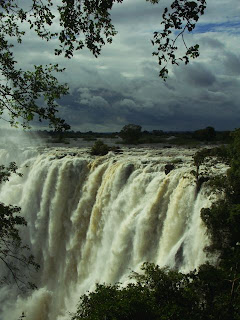

Another view

And one more

The Victoria Falls Bridge: Zambia on the left, Zimbabwe on the right


I next hike down the trail to the Boiling Pot, a part of the Zambezi just downstream from the falls where a giant whirlpool is formed by the swift water. Guided by a local villager, I pick my way through the part of the trail that has now become a swift river and arrive at the swirling cauldron just below the Victoria Falls Bridge that spans the Zambia-Zimbabwe border. I sit on a rock, just listen to the thundering falls and watch the spray roll down the gorge and people bungee-jump off the bridge.

The swirling Boiling Pot


After a filling lunch at the local market, I head back for a stroll along the trail on the other side of the gorge. Baboons sit along the trail, barely bat an eye while grooming each other as I walk by.

View of the Boiling Pot and the Bridge from top of the cliff


Baboons grooming each other

Striking a pose


I originally had wanted to go into Zimbabwe for a day, but the US$40 visa fee plus the US$20 fee to see the falls from the Zimbabwe side make it an expensive proposition. So I settle for just a walk across the bridge, which is free.

Part of Cecil Rhodes' master plan back in the colonial days, Victoria Falls Bridge is open to rail, vehicular, and pedestrian traffic


On the approach to Victoria Falls Bridge, I strike up a conversation with a local. He is a welder from Zimbabwe. Upon learning that I am American, he asks me about my opinion on the U.S. election later in the year. Like most people I talk to in Zambia, he is a big fan of Obama, but is also questioning the feasibility of him being elected president. I, in turn, start asking him about their upcoming election, which is in a little over a week. He says he supports Mugabe and hopes he wins another term. We are now walking past the sign that says “You Are Now Entering Zimbabwe” at the halfway point on the bridge. I start to ask him some pointed questions about Mugabe’s questionable leadership and mismanagement of the country’s economy. He brushes aside the dire economic meltdown, illustrated by the ridiculous price of 7 million Zim dollars for a loaf of bread, and points to sanctions by the West as the main cause for their inflation rate, the world’s highest. He concedes that Mugabe has done some bad things, but he thinks that Mugabe has done much more good for the people of the country. He is optimistic that Zimbabwe will get better soon and those who have fled the country will come back. Citing himself as an example, he tells me that he had gone to Australia to work before, but decided to return because he feels that he is Zimbabwean no matter where in the world he his. I suddenly realize that I am being critical of Mugabe as I am standing on Zimbabwean soil.

He continues his passionate defense of Mugabe and encourages me to go into the country to see for myself. I admire his optimism and I tell him that much. Maybe his is right in some ways. In the tradition of trial by the media in the West, Mugabe has already been convicted a million times over. But inside Zimbabwe, he is probably not universally despised like we’d like to think. And his supporters are not all his party cronies. I know that, on the March 29th election, at least this one vote for Mugabe will be cast in good faith.

We say goodbye, he then walks back toward Zimbabwe immigration; I turn around and go back to Zambia. The sun is starting to dip in the west. The gorge below is now cast in the advancing shadow. I take another look at the falls from the middle of the bridge and step back onto Zambian territory.

A plaque on the Zimbabwean side of the bridge commemorating the engineering landmark. Apparently the American Society of Civil Engineers had a part in it.

Crossing back into Zambia. This is the only No-man's Land between two countries where I can walk back and forth like this without being stopped by people with guns.


Sunday, March 16, 2008

Livingstone Bound

I’ve got only four days left in Zambia. In the last two months, I only got to visit a small waterfall near Mansa and spent a day at Samfya Beach. So I’d better take advantage of these four free days and do some serious sightseeing. The premier attraction and the mother of all waterfalls, Victoria Falls, is near the southern city of Livingstone at the border between Zambia and Zimbabwe.

After a leisurely breakfast, I head to the bus station and catch the next bus to Livingstone. Within minutes of leaving the bus station, we are going through open country. The narrow road is flanked on either side by lush savanna for as far as the eye can see, with a few thatch roofs of village houses dotting the landscape here and there. I half expect to see lions or giraffes or hyenas roaming in the distance. Alas, the lush landscape hides the longstanding human activities that had driven the wild animals off the land long time ago.

The bus rolls down the narrow road, speeding up during smooth sections and slowing down to a crawl to go over the not infrequent pothole-ridden sections. The two TVs on the bus are alternating between some Zambian soap opera, gospel music video, and a couple of Michael Jackson’s music videos. I put on my MP3 player, crank up the volume, and stare out the window. With a soundtrack playing, I start to daydream, something I haven’t done in a long time. It’s like letting my mind go for a walk – just let it wander and see where it goes. I find that the exercise has a certain meditative quality to it.

At noon, the bus stops at a rest stop for lunch. Food at this kind of place is almost the same the world over – something starchy with something greasy. I ask for vegetables, only to be directed toward the pile of fries under a heat lamp. Opting for the least greasy item on the menu – a mystery meat pie – I head back to the waiting bus. In the late afternoon, seven hours after setting off from Lusaka, the bus rolls into Livingstone. I head to the nearest backpacker’s, get a bunk bed in the big dorm room, and walk down the main street.

Being a Sunday evening, most shops are closed. I sit down at a local restaurant and have a meal of nshima with chicken. I know, I’ve been eating nshima everyday for the last two months. But after these four days, I won’t have a chance to eat it anymore. So I will eat it as much as I can before I leave.

Tomorrow I will see Victoria Falls and check out the possibility of crossing into Zimbabwe for a day.