Friday, May 16, 2008

Seven Down, Three to Go

The exam this afternoon marks the end of specialties 1 rotation, which means a one-week break is coming up.

It has only been eight weeks since I’ve been back in Brisbane, but I am already getting itchy feet. So three of my friends and I will be taking off for a week of camping on Hinchinbrook Island National Park in tropical north Queensland where Nim’s Island was filmed. The walk on Hinchinbrook is supposed to be among the world’s top hikes. The last time I camped was back in January in New Zealand; it will be good to go out there and brave the elements again.

Camping gear, check; camping food, check; plane tickets, train tickets, bus tickets, ferry tickets, check, check, check, and check. Hinchinbrook is hard to get to, but good things never come easy.

I’m psyched!

Sunday, May 11, 2008

In Retrospect: Yellowstone National Park

Yellowstone National Park, the world’s first national park, is world-renowned for its geysers, springs, and wildlife. So, on my cross-country drive in July, 2004, I spent two nights camping at one of the campgrounds inside. Two-and-half days are definitely not enough for a national park of this size and diversity, but that was all the time I had.


Yellowstone National Park is located in the northwestern corner of Wyoming


All traffic stops and crowds gather as an elk crosses the road


Looks like something out of a Petrie dish. The thermophilic bacteria grow along suitable streams and ponds, the species and color changes depending on the temperature and pH of the water.


Over here the bacteria take on a reddish-brownish appearance


And along this stream, green and brown grow side by side


The Old Faithful – thar she blows!


Many of these creeks are replenished by run-offs from geysers and springs


Hot springs with boiling water like this one are so numerous, many are unnamed


Steam from springs blowing in the late afternoon glow gives the landscape a surreal appearance


Porcelain Basin is encrusted with calcium carbonate


The water of the springs can be clear, or it can be emerald-green, depending on the minerals dissolved in it


Grass and trees are constantly trying to reclaim the land


This spring next to a picnic area looks inviting, but it’s probably not a good idea to jump in - it's boiling


People watching yet another geyser erupt


The size of the Grand Prismatic Spring can only be appreciated from the air, this is just a sliver of it


Morning Glory Spring
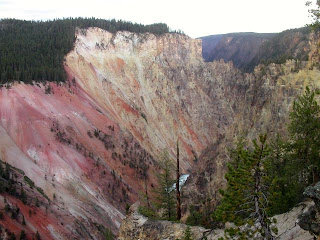

The Grand Canyon of Yellowstone, although nowhere near the size of the one in Arizona, is still quite impressive


The raging torrent looks like a smooth ribbon from this height


With the spring dried up, the white calcium skeleton is what’s left of Minerva Terrace


These unfortunate trees stood in the way of the water spilling out of a spring


View from top of Minerva Terrace


A herd of bison grazing at the foot of the mountain


The road out of Yellowstone and into the big sky country of Wyoming


The road winds its way up the side of a mountain just outside of Yellowstone

Wednesday, May 7, 2008

Regression of the Mind

At memory clinic today, one of the patients was accompanied by her daughter. The patient, in her mid-eighties, was originally from Poland but has lived in Australia for the last forty years. She was diagnosed with Alzheimer’s Disease four years ago and came in today for a follow-up visit. As her daughter described it, the progression of her Alzheimer’s Disease, and her dementia, has made her more and more dependent on her daughter. Besides the lost of her short-term memory, she has almost completely lost her ability to speak English, which she was able to speak fluently before, and now relies on her daughter to translate for her. She happily recounts in Polish stories of her, as a girl, gathering firewood from the forest to make dinner at the eave of Germany’s invasion of Poland.

Ah, the ravage of time, that great equalizer. When people live long enough, few can escape the its grasp. As dementia sets in, the awareness in the early phase evaporates, leaving its victims blissfully oblivious even as it becomes increasingly distressing to their family members. It doesn’t matter whether he might have once been the CEO of a multinational corporation or an ordinary farmer, he simply regresses back to a child-like state. The loss of the ability to make critical judgment, the ability to remember where one lives, the ability to recognize one’s family member, and the loss of skills learned later in life, such as speaking a second or third language, are all part and parcel to the disease. At the end, one becomes dependent even in simple things like feeding and toileting. And thus he leaves this world just like he entered it.

Sometimes I do imagine that if I get to live to the ripe old age when I am babbling in Cantonese, with Mandarin and English, my second and third language, respectively, just a glimmer in the deepest recesses of my atrophied brain, what kind of stories would I be telling my grandchildren or my geriatrician.

Sunday, May 4, 2008

In Retrospect: Mandalay

As the internet carries the news that a cyclone in the Indian Ocean is threatening Myanmar, it brings back memories of my trip to that beautiful country in February 2004. I didn’t spend much time there – just two weeks, but I was especially struck by the beauty of the country and the friendliness of the people. Despite the poverty, the oppressive government, and a generally grim future, the local people I met managed to find something to laugh about everyday.

Mandalay was the capital of the Burma kingdom when it came under British control. Situated along the Irrawaddy River, Mandalay is Myanmar’s cultural and religious center of Buddhism.

Mandalay is in the center of Myanmar


Myanmar is nicknamed the Land of Pagodas for a good reason


This sign is posted on the door of the toilet on the boat we took up the Irrawaddy to Mandalay. There were no local passengers on the boat at the time, so I wasn’t sure if it was enforced.


The Irrawaddy is a major transport route down the length of the country


Dinner at a sidewalk eatery under the buzzing street lamp


Washroom haiku, posted over the toilet at the guesthouse I was staying in


On sale: wheels made with folded low-denomination bills – for offerings at pagodas, for funerals, I’m not quite sure


The street market just outside of my guesthouse, with the bell-shaped pagoda of a monastery at the end of the street


The reconstructed royal palace is now a sterile museum


Intricate woodwork on one of the buildings in the royal compound


The golden paint on the building glint in the afternoon light


A VW Beetle makes its way out of the eastern entrance to the royal compound


People’s Desire: something straight out of 1984


The climb up Mandalay Hill is made easier with the covered walkway


View over the city from top of Mandalay Hill


Novice monks taking a break


The monastery building is bathed in the low afternoon light


Burmese script on the pillar: poetry? scripture? warning signs?


Tourists watching the sunset in the haze at the top of Mandalay Hill

Tuesday, April 29, 2008

Geriatrician or Social Worker?

It’s the second week of geriatrics. And my first impression of this specialty is – it’s a lot of social work! In fact, I would say it accounts for the majority of the work by everyone from the resident up to the consultant. The ward I am attached to is mainly for elderly amputees to go through rehabilitation after their amputation so they can go home with the skills to live as normally as possible.

Although the patients are mostly elderly people who have multiple co-mobidities like diabetes, heart failure, COPD, peripheral vascular diseases, etc., which make them very interesting patients as far as pathology is concerned, their conditions have largely stabilized by the time they are ready to go to the geriatric and rehab ward. So the main focus on the ward is their rehabilitation; their medical conditions have almost become a secondary issue. As they go through the process of going to the gym to gain their strength back and learn to use the wheelchair with help from physiotherapists, the doctors are busy coordinating the allied health team to work on their discharge – home visits to assess access issues in and around their houses, arranging Meals on Wheels for them, booking the Blue Nurses to care for them post-discharge, arranging house-cleaning, and for those not fit enough to live in their own homes, plan for discharge to nursing homes. A meeting is held weekly for doctors and allied health professional to discuss each patient on the ward and to assess their progress and the progress of the work being done to address the patient’s living situation.

While it’s great to see that patients get such thorough treatment to make sure their transition from hospital to home go as smoothly as possible, it appears that this specialty involves more social work than the practice of medicine. Is this the result of the break down in the social fabric of Western societies? Traditionally, people go to the hospital when they are sick; and when they go home, their immediate or extended families take on the role of care takers. Now that role has been assumed by the health care system and, at least in Australia, largely by the government. From a rational point of view, it makes sense – the patients’ family, now unburdened with the work of caring for them, is free to devote their time on work and, by extension, contribute to the national economy. But from the humanistic point of view, the care the patients receive from the various government agencies and professionals, however great, cannot make up for the feeling of being cared for by someone close to them. Of course, many of these patients are fortunately enough to get the best of both worlds: they are under the care of a family member, with help and subsidies from the government. Their main carers can get various benefits like pensions from the government and carer respite to prevent burn-outs. It is reassuring to see that, under the generous welfare state and the social safety net in Australia, people can age with dignity, even with debilitating illnesses.

Sunday, April 27, 2008

In Retrospect: Zion National Park

In July, 2004, I did a cross-country drive from California to Washington, DC. Along the way, I stopped and visited a number of national parks in the western states. Southern Utah consists of a number of national parks, national monuments, and national forests – a great place to be if you like the outdoors.

Map of the US with location of Zion National Park marked


The road leading to Springdale nestled among the mesas


The red-tinged road inside Zion


Angels Landing, the tall rock formation on the left, forms part of the canyon wall


The shuttle bus is just a dot at the bottom of the canyon when surrounded by the massive cliffs


View of Zion Canyon from Observation Point, 670 meters from the canyon floor


The sheer drop off of the cliff offers spectacular views and gives you sweaty palms


Pine trees and cacti coexist here


Rainwater has carved out their preferred course through the sandstone canyon over the years


The layers of the soft Navajo sandstone is revealed after years of the polishing action from raging floods


The canyon comes to a point at The Narrows along the Virgin River

Rock formation and pine tree

The Zion-Mount Carmel Highway winds its way up the canyon wall