Tiger Leaping Gorge, the name alone evokes images of peril, mystique, and majesty. In early December 2003 when I was traipsing around southwestern China, I made sure to do the three-day hike through the gorge. It is not in a national park, nor is it a “protected area”. It is simply a place where people happen to live in a stunningly beautiful setting. Two main trails runs through the gorge: the low trail was being expanded to accommodate cars and tourist buses, the high trail, well trodden by villagers living in the area, remained the footpath that connects the little villages that cling on to the side of the steep mountain. The villages made it possible for people who had no camping gear to see the place. I hiked with a small backpack, ate and slept at guesthouses run by entrepreneurial villagers who took advantage of the fledgling tourist industry being developed around them.
The gorge, flanked by the Jade Dragon Snow Mountain on one side and the Haba Mountain on the other, is reputed to be among the deepest in the world. The jagged peaks of the mountains drop almost four thousand meters to meet at the bottom, a mere twenty meters apart at the narrowest, squeezing the upper Yangtze River through a series of cascades and rapids. I hiked the relatively short high trail with a few other backpackers, enjoyed the warm Naxi hospitality, and visited the bottom of the gorge where legend had it that a tiger had leapt across to safety while being chased by a hunter.
 Tiger Leaping Gorge is located in northern Yunnan Province in southwestern China.
 At the western end of the gorge, the upper Yangtze, also known as Jinsha Jiang or the “Golden Sand River”, flows quietly through relatively gentle terrain.
 Upon entering the gorge on the High Trail, the jagged peaks of the Jade Dragon Snow Mountain was in view.
 The Naxi House was a little guesthouse run by a local Naxi family. The Naxi people are the predominant ethnic minority group living in the area.
 Maize and pumpkins being dried for the winter
 Even the view from the toilet was spectacular.
 Persimmons being dried in the sun
 Higher up on the trail, the full length of the Jade Dragon Snow Mountain came into view.

 I spent the night at the Tea Horse Guesthouse, where I was greeted by the owner with nuts, snacks, and a bong with locally harvested “herbs.”
 The next morning, it took a long time for the sun to rise above the peaks across the gorge.
 After breakfast, the incredibly hospitable Naxi Mama sent us off on our hike.
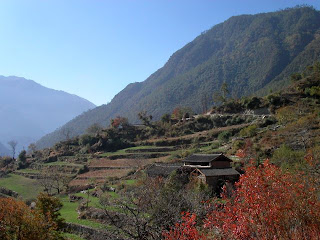 The people carved out terraces and lived off the land.
 The trail wound its way around the mountain, veering precariously close to the edge at places.
 Taking a break with Inbal, Keeley, and John
 The setting sun covered the gorge in a dramatic show of light and shadows.
 The daughter of the owner of Sean’s Guesthouse swept the courtyard clean early in the morning.
 The peaks of the Haba Mountain towered over the little hamlet at the eastern end of the gorge.
 Every inch of arable land had been converted into terrace fields.
 The water buffalo took a break as his elderly owner looked on.
 The height of the mountains allowed the sun to grace the bottom of the gorge for only a couple of hours a day.
 The river roared through the narrowest part of the gorge.
 The vista opened up again at the eastern end of the gorge.
 Venice is a collection of islands scatter through the lagoon, with the main island connected to the mainland by a train bridge.
 View of San Marco Square from the poor-man’s gondola – the utilitarian water-taxi
 San Marco Square was deserted in the early dawn.
 At this early hour, the famous and famously annoying pigeons were the only visitors to San Marco Basilica and Campanile.
 The gondolas were moored to pylons at the end of San Marco Square with San Giorgio Maggiore Island in the background.
 Later in the day, the gondolas would be put into service for all the tourists who wanted that romantic ride through open sewage, er, I mean the canals.
 The juxtaposition of gondolas and a warship
 The water lapped at the edge of San Marco Square. Flooding has become a common occurrence in recent years due to both the gradual sinking of the city and rising level of the sea.
 Gondolas going under the Bridge of Sighs
 Get your tschochke along the waterfront
 Art student or watercolor master?
 While gondola rides are considered a must-do in Venice, we got around by the much more utilitarian water-taxi.
 Just a quiet corner in some back canal
 All the ubiquitous gondolas were starting to make the whole place feel like a theme-park, only tourists were riding them, after all.
 Out on the Island of Burano, the residents must have been competing to see who has the house with the loudest colors.
 An American suburban neighborhood association president would surely go apoplectic upon laying eyes on such gross violation of uniformity and the distinct lack of beige.
 Filling up on gelato


