Today I am on a whirlwind tour of Sydney. But it doesn't involve the Harbour Bridge; there's no visit of the Opera House; nor am I getting anywhere near any of the beaches. Today is a day dedicated to satisfying the Australian bureaucracy.
I got back to Brisbane early yesterday morning. I went over to the med school to pick up my diploma, had coffee with a good friend who is heading back to Canada, went back to the place I last lived and re-packed my bag - I needed to dump out my travel gear and pack some work clothes - and headed back to the airport for a night flight to Sydney.
The flight was delayed - first by twenty minutes, then it became half an hour, then it stretched to forty-five minutes. At the end, the flight was one-and-half hours late. I flew on Virgin Blue, another budget airline - well, you got your hits and you got your misses. My housemate picked me up from the airport. By the time I got to Wollongong and settled into the hospital quarters, it was well past midnight.
Which brings us to this morning. My housemate is taking me on a tour of the backstreets of Sydney, but mainly to visit two places: the New South Wales Medical Board and the Department of Immigration. I am supposed to start orientation for work next Monday, but I don't have my work visa sorted yet. Besides the mountain of supporting documents I had submitted, Immigration wanted to see my diploma and registration with the Medical Board. The New South Wales Medical Board requires that all interns coming in from out of state to register with them in person.
With my diploma in hand, I walk into the Medical Board. Registration itself is actually a pretty painless affair, it takes all of ten minutes; the most difficult part is getting to their office. Then next step is to drive to Immigration and convince them that I have in fact graduated from medical school and am now a registered doctor. It is one of those take-a-number-and-wait affairs, not unlike what one would do at the supermarket deli, except in this case, my fate - whether I will be able to work in Australia or be packed off onto the next flight out of the country - is firmly in the hands of the person behind the counter. With my paperwork handed over to them, my day is finished. The only thing I can do now is to wait while my paperwork churns through the mysterious workings of the innards of the Australian bureaucracy. Perhaps the planets will align and the person processing my paperwork will come back from holiday in a good mood and I will get my visa on time to start my orientation next week. At this point, I kind of wish that I can grease some palms and get things sped up a bit.
Or maybe I will occupy myself with the next task - looking for a place to live.
Showing posts with label travel. Show all posts
Showing posts with label travel. Show all posts
Wednesday, January 7, 2009

Monday, January 5, 2009
Back to Oz
Vacation is over; I am heading back to Australia. I am flying the no-frills Tiger Airways from Macau to Singapore. After a seven-hour layover, I will be flying the red-eye on Qantas from Singapore to Brisbane.
Macau International Airport is a shiny and modern airport built on reclaimed land. With only a few small airlines operating out of it, the airport feels deserted when I check it. Within ten minutes, I have checked in, cleared customs, and am sitting in the departure hall. With almost two hours to kill before my flight, I occupy myself on the free internet terminal by the boarding gate. The sun beams in through the glass-and-steel eastern facade of the terminal, casting a warm glow on the lounge chairs, the shops, and the waiting passengers in this brisk morning. With a cup of coffee in hand, I stare out onto the single runway that appears to be floating just above the shimmering South China Sea. It is still close to an hour before my flight. My eyes look out toward the horizon; the outlying islands of Hong Kong seem to be faintly visible. My mind wanders here, there, and everywhere. This has got to be the most relaxed I have ever been when waiting for a flight.
A seven-hour layover is just too long to spend inside an airport, even for an excellent one like Singapore's Chang-I Airport. My friend Vignesh, who is a local, has the afternoon free. He meets up with me at the airport. We head into Orchard and the waterfront for a few hours. The tropical afternoon heat hangs heavily over the city; it takes extra effort to just walk along the street, as though we are trying to walk underwater. To revive myself, I have my fill of kaya toast washed down with that most delicious diabetes-in-a-cup: teh tarik. Before long, it's time for me to get back to the airport. I say goodbye to Vignesh, head into the terminal, and get ready for the eight-hour flight ahead.
I'd better get some sleep on the plane tonight. Tomorrow will be a full day of running around Brisbane, capped by a night flight to Sydney.
Macau International Airport is a shiny and modern airport built on reclaimed land. With only a few small airlines operating out of it, the airport feels deserted when I check it. Within ten minutes, I have checked in, cleared customs, and am sitting in the departure hall. With almost two hours to kill before my flight, I occupy myself on the free internet terminal by the boarding gate. The sun beams in through the glass-and-steel eastern facade of the terminal, casting a warm glow on the lounge chairs, the shops, and the waiting passengers in this brisk morning. With a cup of coffee in hand, I stare out onto the single runway that appears to be floating just above the shimmering South China Sea. It is still close to an hour before my flight. My eyes look out toward the horizon; the outlying islands of Hong Kong seem to be faintly visible. My mind wanders here, there, and everywhere. This has got to be the most relaxed I have ever been when waiting for a flight.
A seven-hour layover is just too long to spend inside an airport, even for an excellent one like Singapore's Chang-I Airport. My friend Vignesh, who is a local, has the afternoon free. He meets up with me at the airport. We head into Orchard and the waterfront for a few hours. The tropical afternoon heat hangs heavily over the city; it takes extra effort to just walk along the street, as though we are trying to walk underwater. To revive myself, I have my fill of kaya toast washed down with that most delicious diabetes-in-a-cup: teh tarik. Before long, it's time for me to get back to the airport. I say goodbye to Vignesh, head into the terminal, and get ready for the eight-hour flight ahead.
I'd better get some sleep on the plane tonight. Tomorrow will be a full day of running around Brisbane, capped by a night flight to Sydney.
Sunday, October 26, 2008
In Retrospect: Venice
Not much needs to be said about Venice. Everything about it makes it an attractive destination: the labyrinthine canals, the history behind every building, the festive atmosphere, those gondolas, the colorful houses, even the throngs of tourists. My short trip to Europe with my sister in September 2002 included Venice in the spur-of-the-moment itinerary. Even though we only stayed for two days, the time was well spent getting lost in the backstreets, island-hopping by water-taxi, and filling my daily quota of gelati.
 Venice is a collection of islands scatter through the lagoon, with the main island connected to the mainland by a train bridge.
 View of San Marco Square from the poor-man’s gondola – the utilitarian water-taxi
 San Marco Square was deserted in the early dawn.
 At this early hour, the famous and famously annoying pigeons were the only visitors to San Marco Basilica and Campanile.
 The gondolas were moored to pylons at the end of San Marco Square with San Giorgio Maggiore Island in the background.
 Later in the day, the gondolas would be put into service for all the tourists who wanted that romantic ride through open sewage, er, I mean the canals.
 The juxtaposition of gondolas and a warship
 The water lapped at the edge of San Marco Square. Flooding has become a common occurrence in recent years due to both the gradual sinking of the city and rising level of the sea.
 Gondolas going under the Bridge of Sighs
 Get your tschochke along the waterfront
 Art student or watercolor master?
 While gondola rides are considered a must-do in Venice, we got around by the much more utilitarian water-taxi.
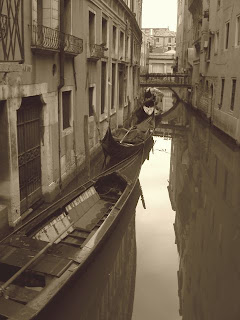 Just a quiet corner in some back canal
 All the ubiquitous gondolas were starting to make the whole place feel like a theme-park, only tourists were riding them, after all.
 Out on the Island of Burano, the residents must have been competing to see who has the house with the loudest colors.
 An American suburban neighborhood association president would surely go apoplectic upon laying eyes on such gross violation of uniformity and the distinct lack of beige.
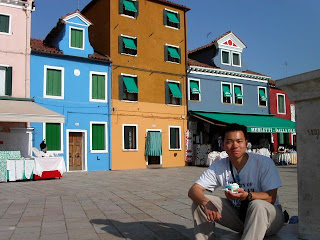 Filling up on gelato
 Venice is a collection of islands scatter through the lagoon, with the main island connected to the mainland by a train bridge.
 View of San Marco Square from the poor-man’s gondola – the utilitarian water-taxi
 San Marco Square was deserted in the early dawn.
 At this early hour, the famous and famously annoying pigeons were the only visitors to San Marco Basilica and Campanile.
 The gondolas were moored to pylons at the end of San Marco Square with San Giorgio Maggiore Island in the background.
 Later in the day, the gondolas would be put into service for all the tourists who wanted that romantic ride through open sewage, er, I mean the canals.
 The juxtaposition of gondolas and a warship
 The water lapped at the edge of San Marco Square. Flooding has become a common occurrence in recent years due to both the gradual sinking of the city and rising level of the sea.
 Gondolas going under the Bridge of Sighs
 Get your tschochke along the waterfront
 Art student or watercolor master?
 While gondola rides are considered a must-do in Venice, we got around by the much more utilitarian water-taxi.
 Just a quiet corner in some back canal
 All the ubiquitous gondolas were starting to make the whole place feel like a theme-park, only tourists were riding them, after all.
 Out on the Island of Burano, the residents must have been competing to see who has the house with the loudest colors.
 An American suburban neighborhood association president would surely go apoplectic upon laying eyes on such gross violation of uniformity and the distinct lack of beige.
 Filling up on gelato
Sunday, October 12, 2008
In Retrospect: Tiger Leaping Gorge
Tiger Leaping Gorge, the name alone evokes images of peril, mystique, and majesty. In early December 2003 when I was traipsing around southwestern China, I made sure to do the three-day hike through the gorge. It is not in a national park, nor is it a “protected area”. It is simply a place where people happen to live in a stunningly beautiful setting. Two main trails runs through the gorge: the low trail was being expanded to accommodate cars and tourist buses, the high trail, well trodden by villagers living in the area, remained the footpath that connects the little villages that cling on to the side of the steep mountain. The villages made it possible for people who had no camping gear to see the place. I hiked with a small backpack, ate and slept at guesthouses run by entrepreneurial villagers who took advantage of the fledgling tourist industry being developed around them.
The gorge, flanked by the Jade Dragon Snow Mountain on one side and the Haba Mountain on the other, is reputed to be among the deepest in the world. The jagged peaks of the mountains drop almost four thousand meters to meet at the bottom, a mere twenty meters apart at the narrowest, squeezing the upper Yangtze River through a series of cascades and rapids. I hiked the relatively short high trail with a few other backpackers, enjoyed the warm Naxi hospitality, and visited the bottom of the gorge where legend had it that a tiger had leapt across to safety while being chased by a hunter.
 Tiger Leaping Gorge is located in northern Yunnan Province in southwestern China.
 At the western end of the gorge, the upper Yangtze, also known as Jinsha Jiang or the “Golden Sand River”, flows quietly through relatively gentle terrain.
 Upon entering the gorge on the High Trail, the jagged peaks of the Jade Dragon Snow Mountain was in view.
 The Naxi House was a little guesthouse run by a local Naxi family. The Naxi people are the predominant ethnic minority group living in the area.
 Maize and pumpkins being dried for the winter
 Even the view from the toilet was spectacular.
 Persimmons being dried in the sun
 Higher up on the trail, the full length of the Jade Dragon Snow Mountain came into view.

 I spent the night at the Tea Horse Guesthouse, where I was greeted by the owner with nuts, snacks, and a bong with locally harvested “herbs.”
 The next morning, it took a long time for the sun to rise above the peaks across the gorge.
 After breakfast, the incredibly hospitable Naxi Mama sent us off on our hike.
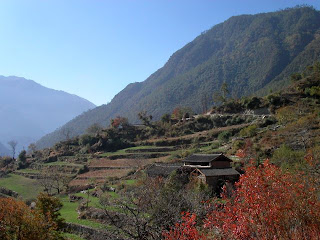 The people carved out terraces and lived off the land.
 The trail wound its way around the mountain, veering precariously close to the edge at places.
 Taking a break with Inbal, Keeley, and John
 The setting sun covered the gorge in a dramatic show of light and shadows.
 The daughter of the owner of Sean’s Guesthouse swept the courtyard clean early in the morning.
 The peaks of the Haba Mountain towered over the little hamlet at the eastern end of the gorge.
 Every inch of arable land had been converted into terrace fields.
 The water buffalo took a break as his elderly owner looked on.
 The height of the mountains allowed the sun to grace the bottom of the gorge for only a couple of hours a day.
 The river roared through the narrowest part of the gorge.
 The vista opened up again at the eastern end of the gorge.
The gorge, flanked by the Jade Dragon Snow Mountain on one side and the Haba Mountain on the other, is reputed to be among the deepest in the world. The jagged peaks of the mountains drop almost four thousand meters to meet at the bottom, a mere twenty meters apart at the narrowest, squeezing the upper Yangtze River through a series of cascades and rapids. I hiked the relatively short high trail with a few other backpackers, enjoyed the warm Naxi hospitality, and visited the bottom of the gorge where legend had it that a tiger had leapt across to safety while being chased by a hunter.
 Tiger Leaping Gorge is located in northern Yunnan Province in southwestern China.
 At the western end of the gorge, the upper Yangtze, also known as Jinsha Jiang or the “Golden Sand River”, flows quietly through relatively gentle terrain.
 Upon entering the gorge on the High Trail, the jagged peaks of the Jade Dragon Snow Mountain was in view.
 The Naxi House was a little guesthouse run by a local Naxi family. The Naxi people are the predominant ethnic minority group living in the area.
 Maize and pumpkins being dried for the winter
 Even the view from the toilet was spectacular.
 Persimmons being dried in the sun
 Higher up on the trail, the full length of the Jade Dragon Snow Mountain came into view.
 I spent the night at the Tea Horse Guesthouse, where I was greeted by the owner with nuts, snacks, and a bong with locally harvested “herbs.”
 The next morning, it took a long time for the sun to rise above the peaks across the gorge.
 After breakfast, the incredibly hospitable Naxi Mama sent us off on our hike.
 The people carved out terraces and lived off the land.
 The trail wound its way around the mountain, veering precariously close to the edge at places.
 Taking a break with Inbal, Keeley, and John
 The setting sun covered the gorge in a dramatic show of light and shadows.
 The daughter of the owner of Sean’s Guesthouse swept the courtyard clean early in the morning.
 The peaks of the Haba Mountain towered over the little hamlet at the eastern end of the gorge.
 Every inch of arable land had been converted into terrace fields.
 The water buffalo took a break as his elderly owner looked on.
 The height of the mountains allowed the sun to grace the bottom of the gorge for only a couple of hours a day.
 The river roared through the narrowest part of the gorge.
 The vista opened up again at the eastern end of the gorge.
Sunday, September 28, 2008
In Retrospect: Bagan
I had never heard of Bagan until I went to Myanmar (a.k.a. Burma) in February, 2004. It is THE place that gave Myanmar the nickname “The Land of Pagodas”. With thousands of temples and pagodas in various styles and sizes built between the 1000s and the 1200s while it was the capital of the Burmese Empire, Bagan exuded an air of otherworldliness. I stayed in Bagan for four days and explored on a rented bicycle the maze of dirt tracks connecting many of the pagodas scattered throughout the plains. It would take someone with a degree in archeology and Burmese history to fully understand the different styles and significance of the pagodas. Content with a simple description and explanation from my Lonely Planet guidebook for the major pagodas, I just enjoyed the artistry of the architecture and the relative isolation of the place. Pagoda fatigue notwithstanding, I relished the moments of watching sunsets while perched atop one of the taller pagodas, enjoying the delicious local food at roadside restaurants, and talking with the locals at juice stands and at the riverbank.

 Sunrise from one of the smaller pagodas near my guesthouse
 From the top of Shwesandaw, the countless pagodas dotting the now parched plains came into view. The lush vegetation would return when the monsoon came later in the year.
 With very little vehicular traffic around, the trishaw was a cheap and efficient way for people to get around.
 Vendors hawked souvenir at the more popular pagodas.
 Shrines like this one, scaled to the appropriate size, are always found inside the pagodas.
 This little kid sat with us at dinner. He was wearing thanaka on his face like many children and women in Myanmar.
 This lady at our guesthouse made thanaka by grinding a log of thanaka wood on a piece of stone. Thanaka is worn as a cosmetic, sunscreen, and skin conditioner mostly by women and children.
 With the cooling sensation of the freshly applied thanaka on my face and the drafty longyi tied around my hips, I was now ready for the oppressive heat of the dry season.


 Lacquer ware was a famous local craft.
 When parched from riding around the dry dirt tracks, a glass of freshly squeezed sugar cane juice was all you’d need.
 Goats grazed in the shadows of the Ananda Temple.

 Workmen repairing a sign in front of one of the pagodas

 Ananda Temple, like many of others here, was still being used by the locals as a place of worship.

 The afternoon sun streamed through a window inside the Ananda Temple.
 This gilded statue of Buddha received many offerings from the locals.


 Dinner consisted of rice with little dishes of delicious Burmese curries.
 Sunsets were always magical in a setting like this.


 The lifeline for much of Myanmar, the Irrawaddy River is a place where people do their daily bathing and washing.

 Sunrise from one of the smaller pagodas near my guesthouse
 From the top of Shwesandaw, the countless pagodas dotting the now parched plains came into view. The lush vegetation would return when the monsoon came later in the year.
 With very little vehicular traffic around, the trishaw was a cheap and efficient way for people to get around.
 Vendors hawked souvenir at the more popular pagodas.
 Shrines like this one, scaled to the appropriate size, are always found inside the pagodas.
 This little kid sat with us at dinner. He was wearing thanaka on his face like many children and women in Myanmar.
 This lady at our guesthouse made thanaka by grinding a log of thanaka wood on a piece of stone. Thanaka is worn as a cosmetic, sunscreen, and skin conditioner mostly by women and children.
 With the cooling sensation of the freshly applied thanaka on my face and the drafty longyi tied around my hips, I was now ready for the oppressive heat of the dry season.

 Lacquer ware was a famous local craft.
 When parched from riding around the dry dirt tracks, a glass of freshly squeezed sugar cane juice was all you’d need.
 Goats grazed in the shadows of the Ananda Temple.
 Workmen repairing a sign in front of one of the pagodas
 Ananda Temple, like many of others here, was still being used by the locals as a place of worship.
 The afternoon sun streamed through a window inside the Ananda Temple.
 This gilded statue of Buddha received many offerings from the locals.


 Dinner consisted of rice with little dishes of delicious Burmese curries.
 Sunsets were always magical in a setting like this.


 The lifeline for much of Myanmar, the Irrawaddy River is a place where people do their daily bathing and washing.
Subscribe to:
Posts (Atom)
