Tuesday, December 12, 2006

Quy Nhon to Dai Lanh

Quy Nhon has a nice little beach with a broad beachfront promenade. With the fancy hotels springing up at the beachfront, it is developing into a nice beach town. But for now, it's still a laid back small town overshadowed by the hugely popular Nha Trang to the south, and so it has few tourists around. It's a nice enough town to hang around for a few days. But for me, that'll have to be next time, because I'm on a schedule to meet up with Chris, my riding partner for the final week of my trip.

As I'm packing up my bike to leave the hostel, someone comes down the stairs with panniers in tow. Glad to see another cyclist, I start to talk to him. After a brief conversation and finding out that we're going the same direction, Adrian from Switzerland and I decide to ride together for the day.

Heading out of Quy Nhon, we're immediately greeted by a substantial climb up a mountain pass. Fortunately, traffic is light and we coast down the mountain at a good clip. The coast down these hills is always worth the effort it takes to get to the top.
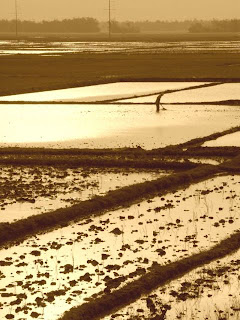
For the rest of the day, we go through what is familiar by now: wave to friendly passers-by and kids at the side of the road and ride through scenery ranging from busy roadside markets to rice paddies stretch to the horizon to little villages hemmed in by mountains. Vehicular traffic is light today, so we occupy the whole shoulder lane and fly down the highway.

As dusk approaches, we're still twenty kilometers from our destination Dai Lanh. Deo Ca is the mountain pass just before the town. We have no choice but to press on. Deo Ca is a relatively high mountain pass with 3.5 km of climbing. We put on our flashing back lights and start the climb. Thankfully the road surface is perfectly paved with no potholes. We get to the top without too much drama save for a little section where we have to go over dug-up roads under construction. Coasting down the other side is another experience all together. Barely making out the contours of the road under the dim moonlight, our downhill glide has to be carefully controlled lest one or both of us crash onto a fallen rock. The occasional passing car provides enough illumination to allow us a faster ride. Towards the end, a girl on a motorbike goes slow enough for us to keep up and leads us all the way into the town of Dai Lanh.

Looking for the sole hotel in town, we are lead down a dirt track next to the railroad. We stop to ask directions in front of a crumbling house. A young woman laughs and starts to make suggestive gestures at us while pointing to the house. We walk past a few more houses and encounter the same explicit invitation. Finally, we find the hotel, and are grateful the hotel is not the type that charges by the hour. Later, while going to dinner, we are met by young women at the side of the road waving at us invitingly. We learn that Dai Lanh has been nicknamed "Truckers' Delight." The whole town is basically a giant red-light district where the world's oldest profession flourishes. Looking for some alternative entertainment, we end up shooting pool with a kid from the roadside restaurant where we had dinner.

Stats:
Distance: 142.9 km
Time: 6h 4m
Average speed: 23.5 kmph
Maximum speed: 58.0 kmph
Odometer: 1074.5 km

Monday, December 11, 2006

Duc Pho to Quy Nhon

Today I have a one-track mind: to pedal the 140 km to Quy Nhon before it gets dark. Last time I did over 100 km I had to do the last 10 km in the dark. That wasn't so much fun.

Last night I heard rain throughout the night, but it looks like the weather is cooperating this morning. I'm out the door at 8 am. Three kilometers later, it's breakfast time. Fifteen minutes and two bowls of pho later, I'm back on the road.

The Vietnamese diet is perfect for cycling. It's high in carbs and low in fat and protein. Whether it's pho, bun, or rice, it always comes with a bit of meat and salad. The portions are big enough to fill me up, but small and light enough that I won't feel bloated or lethargic after the meal. When I'm on the road, I often pop into one of the countless roadside stalls selling these tasty noodle soups throughout the day. A bowl or two of noodle soups are enough to propel me through the next twenty kilometers or more.

After lunch, I'm back on the road. The midday heat makes me search for a good spot for a break. In a village, I spot a lush area in front of a drink stall with a bunch of green coconuts on the ground. Under the trees, a few hammocks swing idly with the breeze. Perfect! I lean my bike against one of the trees, order two coconuts from the drink lady, and stretch out on a hammock. With the breeze gently blowing, I lay in the hammock and drink the sweet coconut juice. My eyes gaze upwards through the trees and at nothing in particular. I can spend the rest of the day like this, I think to myself.

But my one-track mind wins the day. A half hour later, I'm back on the road, pedal to the meta...uh, pedal to the...whatever, my legs are back in automatic mode: push, push, push. I wave to the kids yelling hello from inside their houses, exchange glances with passengers on passing buses, and nod hello to farmers on the side of the road taking a break from work. With the wind blowing past my ears, I fly down the road. Some parts of Highway 1 follows the undulating hills. I power up each hill, then enjoy the coast down to the trough, then up the next hill, then down...

Towards five o'clock, I ride into the center of Quy Nhon. After looking at a couple of hotels, both offer rooms for $10, I pedal on, in search of one that offers cheaper rooms. By chance, I happen upon a backpacker's hostel by the beach. "Do you have dorm beds?" I ask. "Yes, 40,000 dong per night." That's music to my ear.

I push the bike up the ramp into the hostel as the last ray of light evaporates and darkness covers the sky. Mission accomplished!

Stats:
Distance: 139.9 km
Time: 6h 4m
Average speed: 23.1 kmph
Maximum speed: 54.5 kmph
Odometer: 931.5 km

Sunday, December 10, 2006

Country Hospitality and Memorial to an Atrocity

Despite the hard plank bed, I sleep through the night like a baby. At six o'clock in the morning, I wake up to the chorus of crowing roosters outside. For a second, I don't remember where I am. But the familiar voices of Chuong and Thu talking outside immediately brings yesterday's events back to me. Feeling refreshed, I roll out of bed.

The rain has stopped, the sky is still overcast. I walk outside and see Chuong, his mother, and Thu already tending to their livestock. "Xin Chao!" I say to the three of them. "Good morning," Chuong replies in English. "Did you sleep well?" he asks. "Like a baby," I assure him.

I ask to use their outhouse. By the time I come back, breakfast is already sitting on the table in the living room. We sit down for a delicious meal of chicken rice porridge. Then it is time to say good bye to Chuong's mother. At this point, I am kicking myself for not having brought anything to give her as a token of gratitude. As I say good bye, I try to give her some money as a way to say thank you. She steadfastly refuses to take it, as do Chuong and Thu. The only thing they want is for me to take a few snap shots of them and send them the pictures. I happily oblige. After a cup of coffee with Chuong and Thu, I say good bye to everyone at Chuong's cousin's shop and ride towards My Lai. My sneakers are still soggy from yesterday's rain, so I strap them to the rear rack and ride in my thongs.

As I ride slowly down the road, I replay in my head the events that happened in the last fifteen hours: the chance encounter, the halting conversation, the invitation, the feast, a night in the humble house... I am astonished by these people's generosity. It is clear that, although not mired in wrenching poverty by local standards, they are by no means rich. Yet they go out of their way to show a foreigner they barely know the kind of hospitality no amount of money can buy. It is the kind of hospitality to which even a free stay at the most luxurious five-star resort would pale in comparison. Did I take a huge risk by accepting their invitation to their home? Sure! But if I were averse to risk-taking, I would not even have left home in the first place. And maybe "never take candy from strangers" is not such a hard and fast rule after all. In fact, candy from strangers tastes extra sweet.

With this going through my head, I ride through a few small villages. The road is a mix of decaying paved surface and compacted dirt road. I slow down and follow the somewhat smooth trails on the road formed by countless wheels that have gone by before.

At noon, I reach the village of My Lai, site of the 1968 massacre of hundreds of civilians, mostly women and children, by American soldiers. The village looks like any ordinary Vietnamese village save for the memorial and museum built at the original site of the massacre. I park my bike and walk in to the museum. A simple but effective exhibit recounts the bloody morning of March 16, 1968. Walking past graphic photographs of the lifeless bodies of the elderly, men, women, children, and babies strewn across fields and roads, crude models of US soldiers firing at civilians, and reading about the cover-up that happened afterwards, I can't help but think of what is going on right now in Iraq. I desperately hope that we will not one day learn about a My Lai of Iraq. I come out of the museum and walk around the memorial, part of which consists of foundations of houses razed that morning. The frame and one wall of a burned house stands in front of a concrete statue, memorializing the horrors the villagers faced that day.

For the rest of the day, My Lai weighs heavy on my mind. I ride out of the village and the road rejoins Highway 1. I ride slowly, thinking about the emotional up and down I experienced today. Time passes by as the wheels roll past one town after another. In the late afternoon, I decide to stop at the drab town of Duc Pho for the night.

Stats:
Distance: 87.6 km
Time: 4h 16m
Average speed: 20.4 kmph
Odometer: 791.6 km

Saturday, December 9, 2006

Strangers with Candy

Throughout the night, I hear rain coming down in sporadic downpours. By dawn, the sky is gray, but the road is dry and people are out and about. After a filling breakfast of fruit, baguettes with cheese, and coffee, I strap the panniers on the bike and leave the enchanting Hoi An. Now the panniers are a couple of kilos heavier, thanks to the shirts and pants I had tailor-made at one of the shops.

The road goes through a couple of small villages before joining Highway 1. The scenery changes from anonymous and drab-looking towns to verdant rice paddies stretching to the horizon with small houses and huts dotting the landscape.

In the afternoon, the sky starts to darken. Then rain, first a few drops here and there, becomes a drizzle, then the sky opens up and comes a downpour. I duck into a roadside drink stand to wait it out. Swinging on a hammock and sucking on coconut juice through a straw, I really think I can get used to this.

The rain soon passes. I reluctantly roll off the hammock and start riding again.

In an hour, another downpour. Completely drenched, I stop at a tea house along with a few other people to wait out the rain. As I lean my bike against a fence post, a young couple on their motorbike rush in. I take out my map and ask them if they can point out where I am at the moment. As we start talking, I find out that Chuong and Thu are in their late twenties, have recently gotten married and moved up from Saigon. They live in a village outside of the next town five kilometers down the road. The conversation is a bit of a struggle as they reach for words, but much better than other talks I've attempted with the locals where I'm the one butchering the pronunciation of Vietnamese words. As the rain turns into a fine drizzle, they ask if I'd like to have coffee.

Sitting in a roadside cafe, we find out more about each other. I tell them the basics about myself and ask them about their family, jobs, etc. The rain gets heavy again. They look at each other, then invite me to spend the night at their home.

I hesitate for a split second. I hardly know these people, is it safe? It's the adult equivalent of taking candy from strangers. This could be the best experience on this trip, or it could turn into a nightmare. Are they planning on luring me into going somewhere with them, then kill me for my money and passport, or at least rob me? As these thoughts flash through my mind, I decide that it's one of the occasions where I should use my gut feeling - and my gut feeling says "Go for it!"

I ask them to repeat it again just to make sure I am hearing right. Yes, it is an invitation into their home. I agree, and thank them. With the rain lightening up again, we set off down the road, pass the town of Chau O, and out into the villages.

Stopping at a shop about five kilometers down a country road, Chuong introduces me to his counsin and her children. Like many people in small towns and villages, they operate a small shop in front of their house, selling snacks, coffee, and gasoline. As my gut instinct tells me again that these are genuinely hospitable people, I take the panniers off my bike when night falls. Then in a flash, the power is cut. Chuong says nonchalantly, "The electricity is out again." Apparently this is a common occurrance in his village.

Wanting to change out of my wet clothes, I ask for the bathroom where I can take a shower. I'm lead to the back of the house. Using gestures, Chuong's cousin tells me that there's no shower, but I can scoop water out of a bucket to wash. He then proceeds to use a bucket tied to a rope to take water out of a well. It'll be a cold wash, thankfully it's a warm evening. I'm now no stranger to washing by scooping water over my head.

After the refreshing "shower," I go back out to the front and chat with Chuong and Thu. Despite my hungry and grumbling stomach, I sit patiently for dinner. After an hour or so, Chuong tells me dinner is ready.

I turn around and see a beautiful spread of dishes sitting by candlelight on the sparklingly shiny tile floor. While I was in the bathroom, I heard a chicken being slaughtered. And here it is, being served up in a couple of plates. People stream in and take their seat on the floor, forming an oval around the food. Chuong's whole extended family is here: uncles, aunts, cousins, and children of various ages are all sitting down, talking to Chuong, and throwing glances and smiles at me.

Dinner starts with a round of cheers with beer. I normally don't drink, but this time I feel obligated to have a couple of glasses of beer. The food is most delicious - the best meal I've had on this trip: flavorful chicken with fresh basil; small spring rolls wrapped with pork and Vietnamese salad in rice paper, then dipped in light fish sauce; rice porridge cooked with chicken broth. I remind myself not to attack the food like I usually do after a long day of riding, but still help myself to helping after helping of the food. The beer is free-flowing among the other men in the circle. After the second glass, one of them takes out a bottle of the potent rice wine. This is where I draw the line. Running the risk of offending the hosts, I steadfastly refuse shots of the nosehair-wilting potion. Fortunately, they understand and I get away with just sipping beer.

After dinner, it's time to head to Chuong's house for some sleep. Chuong and Thu live with Chuong's brother and mother in a modest house next to the rice paddy they farm with a pig pen in front and chickens running among the trees. I sleep in the living room on a wooden bed covered by a frayed straw mat with a pink mosquito net hanging over it.

As I drift off to sleep, the rain starts to come down again, softly tapping on the roof; the trees outside rustle as the wind blows.

Stats:
Distance: 105.6 km
Time: 4h 44m
Average speed: 22.3 kmph
Odometer: 704.0 km

Friday, December 8, 2006

Hoi An

I came to Hoi An last year. It was raining the entire time so I did not get to see much. The sunny and balmy weather today is a nice contrast to the gray and wet Hue. I am told that it was good timing on my part to have arrived yesterday. It had been raining for quite a few days before that and a couple of streets near the river were flooded. Today the water has receded, leaving a slippery coat of mud on the streets and sidewalks next to the river.

A far cry from its heyday as a major international port when the Portuguese and the Dutch ruled the high seas, Hoi An is now a living museum with a charming juxtaposition of the modern and the traditional. It is a pleasure to walk around the compact Old Town. The narrow streets, lined by houses in various stages of decay and restoration, are open only to motorbikes and bicycles. These houses now contain residences, restaurants, specialty shops, tailor shops, and boutiques. While many of these shops and restaurants cater to foreign tourists, the locals going about their daily activities in the streets and at the central market prevent the town from turning into a theme park.

Strolling past the central market, I come upon Lan's tailor shop. I had a couple of shirts and pants made here last year and I was very happy with what I got. Well, I am here, I think I will have a few more made. So I walk in and, to my surprise, Lan recognizes me. I am keenly aware that whatever I buy, I will have to haul all the way down to Saigon with me. With that in mind, I limit myself to two shirts and two pairs of pants. After she finishes measuring me, Lan tells me, "Every measurement is bigger by two centimeters compared to last year. Looks like you gained about five kilos." I beam proudly, "That's right, but it's a lot of hard work to gain those five kilos." Giving me a motherly disapproving look, Lan says, "I will give you extra fabric in the seams so you can let out the pants next year." What, does she expect me to balloon up to 100 kilos next year?

Used to dealing with customers who have short stops in town, Lan's tailor shop is able to have my clothes made and fitted within twenty four hours. After dinner, I walk over to the shop and pick up the finished product. After bidding them good bye, I stroll down the winding streets cast in a shade of yellow by the street lamps.

I hope the weather will be good tomorrow, because I will get on my bike again and head farther south, now with my panniers a couple of kilos heavier.


Lantern Shop


School Girls in Their White Ao Dai

Just Passing Through

Thursday, December 7, 2006

Over Hai Van Pass

A fisherman and his basket boat in the lagoon by Lang Co


Waking up with the increasing traffic noise from Highway 1 outside the hotel, I walk out to the balcony and look south at the direction of Ai Van Mountain. The peaks are hidden behind swirling mists and clouds. I guess it isn't going to clear out anytime soon, might as well just go for it. I pack up and start riding after a filling breakfast of pho.


One kilometer south of town, the road comes to a fork. To the left, vehicular traffic goes across the new bridge to the recently completed tunnel through the mountain. To the right, the old bridge goes across the lagoon and the road winds up the side of the mountain and over Hai Van Pass. Bikes are not allowed through the tunnel, which is just as well. To me, riding over Hai Van Pass has now become a rite of passage, a test of my physical and mental fortitude.

Another couple of kilometers later, at a sign declaring an 8% grade, the climb starts. I gear down to the lowest two gears, keep the wheels spinning, and stay on the seat. People on passing motorbikes fix curious stares at me, an occasional one gives me the thumbs up. Free from vehicular traffic save for a few that don't want to pay the toll to go through the tunnel, the road itself is now the only challenge before me.


Still spinning, I inch forward and upward at 7 to 12 kmph. Seeing the clouds the road disappears into higher up, I know rain would come sooner or later. Eventually it does, intensely but stops just as quickly as it started. I am wet from head to toe, but can't tell if it's the rain or my sweat. I stop, guzzle water, and push on.


One-and-half hours and ten kilometers later, with the old French fort to my left and drink stalls to my right, I arrive at the top of Hai Van Pass. On either side and five hundred meters below, waves from the South China Sea laps at the deserted beaches. The road that leads up to the pass now becomes a shiny ribbon twisting and turning around the misty pine-covered mountain. I take a deep breath in. The air is fresh and without the scent of car exhaust - I feel good, I feel like I can do anything.


After celebrating with a Snickers bar, I get back on my bike and start on the exhilarating coast back to sea level on the other side. For the next ten kilometers, I hardly have to touch the pedals. With the salty warm ocean breeze brushing past me and the almost-empty road to myself, I let the bike get up to 50 kmph in some places. This has got to be the most fun one can have on two wheels!


Back on flat roads, I pedal on, with frequent breaks of food, sugar cane juice, and my daily kilo of bananas. I ride through Da Nang, stop for some R&R on My Khe Beach, a.k.a. China Beach, then continue on under the hot afternoon sun to Hoi An.


Stats:
Distance: 74.5 km
Time: 4h 28m
Average speed: 16.6 kmph
Odometer: 598.4 km

Wednesday, December 6, 2006

Hue to Lang Co

It has been wet in Hue. The bus I took from Ninh Binh arrived in a gray and drizzly Hue and the rain kept coming down for the following two days. So Typhoon Durian struck Nha Trang yesterday and royally stunk up my plans. I tried to stay put in Hue for a couple of days, but couldn't deal with the persistent cyclo and moto drivers and the kids asking for money every corner I turned. When the sun comes out briefly this morning, I decide to pack up and leave town.

After pedaling for twenty kilometers, the sky opens up again. First in spurts of small drizzles, then it really starts to rain in earnest. At first I take little breaks under shop awnings and wait for the spurts of drizzles to pass, then continue on. Eventually I get wet enough and the rain is heavy enough that there is no point in going for cover anymore. I buy a sturdy poncho, throw it on, and keep riding.

The poncho is pretty heavy duty, it keeps the rain out pretty well. But the thick plastic that keeps the rain out also traps sweat in. Soon I am soaked through by my own sweat. I get really annoyed - at nothing in particular, just grumpy from being wet. I ignore the kids yelling "HELLO!" and waving at me along the way, put my head down and focused on pedaling. An hour later when I pass a village, I see a noodle stand and decide to stop for lunch.

Peeling the poncho off my body, I stand in front of the noodle shop, dripping wet and looking like a drowned rat. I squeeze out a smile and order two bowls of noodles and some hot tea. It must be the food, because after the two bowls of noodles and the tea, I feel much better. I am still wet, but I don't care that I am wet anymore. Throwing the poncho back on, I head off into the drizzle again, except now I am not grumpy anymore.

I actually start to think it fun to be riding in the rain. I am soaking wet, water is seeping into the poncho and running into my eyes, muddy water is being thrown upward by the tires, wind gusts are trying to push me back, and I am humming R.E.M.'s "It's The End of the World As We Know It." (I usually have a soundtrack in my head when I ride. I have no control over it. It's just whatever happens to pop up at the moment.) I wave back to the kids and talk to a couple of them who decide to ride along with me for a couple of kilometers.

Late in the day, the road goes up a couple of minor mountain passes. At 7% grade over a couple of kilometers each, they're the perfect warm up for tomorrow's mighty Hai Van Pass. Slowly inching up the gradient, I wave at the passengers on buses laboring up the same slopes - then enjoy an exciting downhill coast.

At four o'clock, I ride into Lang Co, a sleepy town along the coast. The menacing Ai Van Mountain, at over one thousand meters tall, looms large a couple of kilometers down the road; its black peaks hidden behind rolling clouds.

Time to rest up. Tomorrow morning, Hai Van Pass is the first thing to be conquered.

Stats:
Distance: 72.7 km
Time: 4h 5m
Average speed: 17.8 kmph
Odometer: 523.8 km